
From Background Noise to Game-Time Focus: How Audio Captures Attention Differently
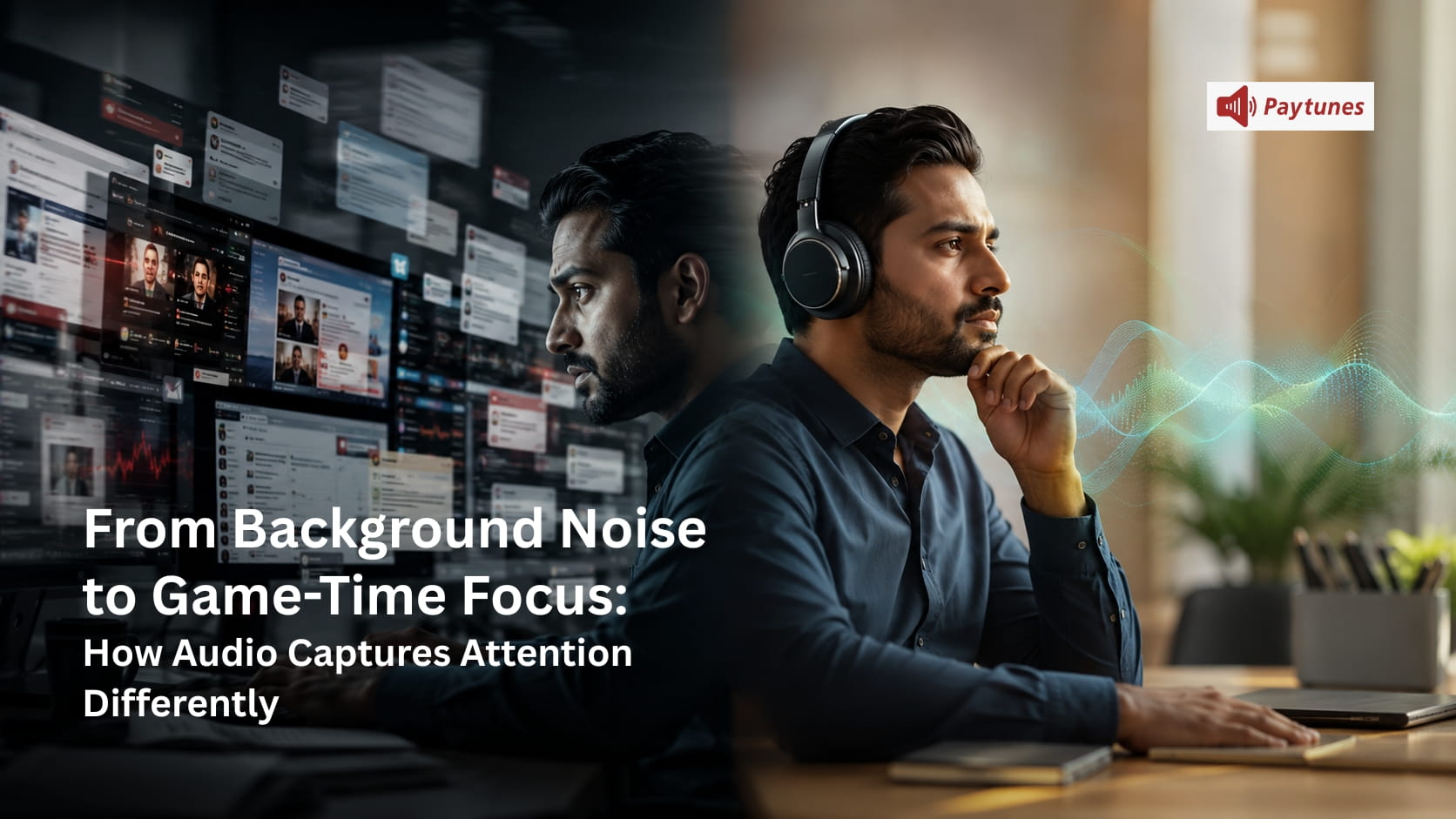
On a Women’s World Cup match day or FIFA World Cup match day, almost every brand is fighting for the same thing: a pair of eyes that are already taken.
The television is on. Live scores refresh on one tab, social media buzzes on another, and a group chat erupts with every near-miss. Visually, the fan is maxed out, several screens competing for one pair of eyes at the same time. And the day doesn’t pause for the match: people are still working, commuting, cooking, and heading to the gym. The game is the emotional centre of their day, but their eyes are rarely free to give it.
So here’s the question worth asking: if screen-time is this scarce and this contested, why are so many brands still spending all their attention budget there?
Because there’s a second resource hiding in the same moment, and hardly anyone is competing for it.
Screen-time is finite. Ear-time is fluid.
Screen-time is a fixed, crowded slot. You either win the glance or you don’t, and on match day you’re up against the broadcast, the scoreboard, the timeline, and the chat all at once.
Ear-time is different. It isn’t a slot to be won, it travels with the listener through the entire day, into places a screen can’t follow. And the imbalance in how brands treat it is striking: according to the AdsWizz State of Audio Adtech Report 2025, cited on the Paytunes blog, audio now commands 31% of total media time but receives only 9% of advertising spend, a 22% gap between how much people listen and how much brands invest. During a tournament like the Women’s World Cup or the FIFA World Cup, when listening hours climb even higher, that gap becomes one of the clearest openings on the whole media plan: high attention, low competition.
Audio doesn’t fight for attention. It fits into life.
Audio moves with the fan, not against them
Follow a fan through a tournament day and the listening journey almost maps itself:
- The morning commute: match previews, predictions, and overnight highlights in the earphones.
- Office hours: low-volume commentary or a sports podcast running quietly in the background.
- The gym session: a high-energy playlist carrying the emotion of the tournament.
- Pre- and post-match discussion: creator content, analysis, and reaction clips.
- Quick highlight catch-ups: reliving the key moments without ever needing a screen.
The fan may not visually watch every minute of every match. But through commentary clips, podcasts, streaming, and creator-led conversation, they stay emotionally connected to the tournament, be it the Women’s World Cup or the FIFA World Cup, all day long. Their attention isn’t fragmented, it’s fluid, flowing from the broadcast to the podcast to the playlist to the post-match debate. Audio is the thread running through all of it.
Audio reaches people when their eyes are occupied but their ears are open, on the commute, at the desk, in the gym.
Turn the second screen into your screen
Here’s the move most brands miss. The “problem” of match day, too many screens, divided eyes, is actually audio’s opening. While a fan half-watches the game and half-scrolls their phone, their ears are wide open, and that’s where a message lands cleanly.
This is what Paytunes is built for. Second-screen retargeting pairs an audio ad with a synchronised display banner, so the message a fan hears is reinforced by the screen already in their hand. Voice-activated ads turn a passive listen into an interaction. And AudioPixel connects that ad exposure to real actions like website visits, so a moment of divided attention becomes a measurable touchpoint instead of a wasted one. The crowded second screen stops working against you and starts working for you.
Where Paytunes fits in
Paytunes is India’s only audio DSP, built to help a brand appear wherever people are already listening, not in one isolated slot, but across a single, connected footprint that mirrors the fan’s day:
- 850+ audio apps, including Spotify and JioSaavn, the platforms carrying the playlists and highlight reels that power a tournament.
- Podcasts, home of the previews, analysis, and creator discussion fans turn to before and after every match.
- Voice and Connected environments like Alexa and Connected TV, reaching listeners even when no screen is in hand.
- Metro Train Audio Advertising, capturing the commute, one of the most reliable listening windows of the day.
- Payment soundbox ads across 20M+ soundboxes, reaching people at everyday moments of purchase.
It brings this together with 400M+ unique users, the trust of 600+ brands, hyperlocal pincode-level targeting, built-in retargeting, and a 100% ad completion guarantee, so the message isn’t just served, it’s heard, all the way through.
Key takeaways
- Screen-time is scarce and contested; ear-time is abundant and fluid. Match-day eyes are split across screens, but ears stay open all day.
- The spend gap is the opportunity. Audio takes 31% of media time but only 9% of ad budgets, a 22% gap that widens during big moments.
- The second screen is an asset, not an obstacle. Second-screen retargeting, voice-activated ads, and AudioPixel turn divided attention into measurable action.
- Show up across the journey, not in one slot. Streaming, podcasts, voice, metro, and soundboxes let a brand ride the fan’s whole day with Paytunes.
The takeaway
The biggest cultural moments aren’t experienced in single, focused sittings anymore. They unfold across an always-on listening journey, last night’s highlight on the commute, commentary at the desk, a hyped playlist at the gym, a reaction podcast on the way home.
Visual media asks the fan to stop and look. Audio simply moves with them. With 31% of media time already going to audio against just 9% of spend, the brands that meet listeners inside that journey are playing where attention is high and rivals are few.
So for moments like the Women’s World Cup and the FIFA World Cup, the play is simple: stop fighting for the screen, and start owning the ear.
Ready to claim your share of ear-time before the next big moment kicks off? Talk to Paytunes about your tournament campaign.
Also Read
- Unlock Massive Growth with the Power of Audio Ads
- Spotify Advertising in India
- Metro Rail Audio Advertising
References
Factual claims in this blog are drawn from the following Paytunes pages:
- Paytunes homepage — India’s only audio DSP; 850+ apps; Spotify, JioSaavn, Alexa; metro trains; 20M+ payment soundboxes; retargeting; 600+ brands; 400M+ unique users; 100% ad completion; pincode targeting — https://www.paytunes.in/
- Paytunes blog — Unlock Massive Growth with the Power of Audio Ads (AdsWizz State of Audio Adtech Report 2025: 31% of media time vs 9% of ad spend = 22% gap) — https://www.paytunes.in/blog/unlock-massive-growth-with-the-power-of-audio-ads/
- Paytunes blog — IPL Isn’t Just Watched, It’s Heard (9 of 10 IPL fans on a second screen; eyes divided, ears open) — https://blog.paytunes.in/blog/ipl-heard-not-just-watched/
- Paytunes blog — Digital Audio Advertising Paves the Way for Higher Engagement (AudioPixel, second-screen retargeting, voice-activated ads) — https://www.paytunes.in/blog/digital-audio-advertising-paves-the-way-for-higher-engagement/
- Paytunes — Spotify Advertising in India — https://www.paytunes.in/spotify-ads
- Paytunes — Metro Rail Audio Advertising — https://www.paytunes.in/metro-rail-audio-ads
- Paytunes — About Us (publisher inventory: Spotify, Gaana, JioSaavn, Wynk, Hungama) — https://www.paytunes.in/about-us